
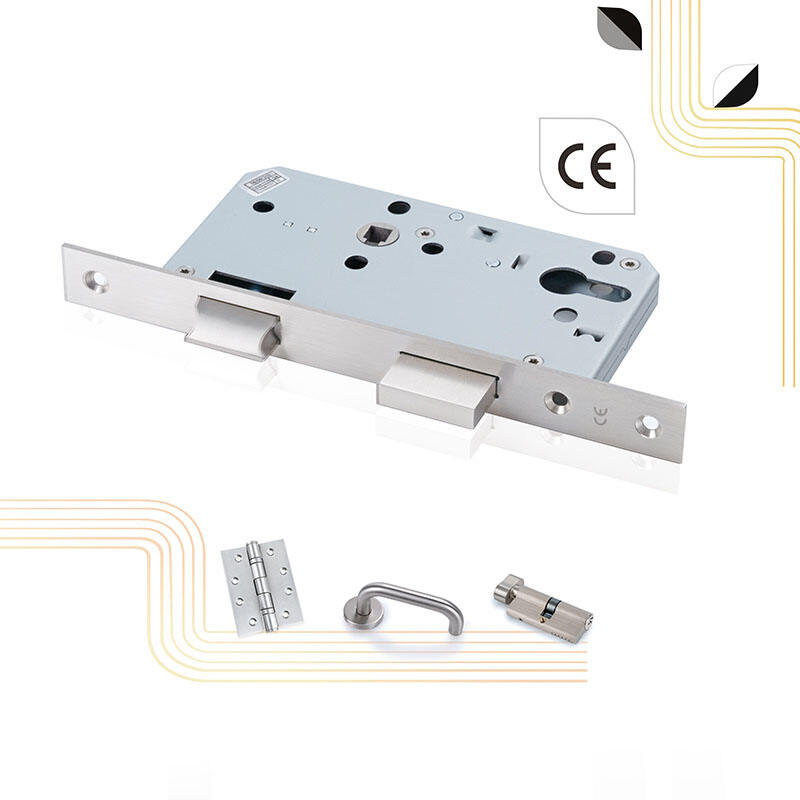
Mortise Locks in Commercial and Institutional Security Applications
Why Mortise Locks Are Preferred in Commercial Buildings, Hotels, and Corporate Facilities
Mortise locks tend to be the go to option in most commercial settings because they're built tough and meet those ANSI/BHMA Grade 1 standards which basically means they're as durable as it gets against forced entry attempts. These locks aren't just slapped on the surface like some cheaper options. Instead, they sit right inside the door frame itself. According to recent security studies from 2023, this construction gives them around 70-75% better protection against break ins compared to regular cylinder locks. What makes mortise systems really stand out though is how flexible they are. The modular setup lets businesses swap out lock cores easily, track who's been accessing what, and set different permission levels for staff members. That's why hotel managers love them when dealing with constant guest changes, and why corporations install them in places where security matters most like data centers or boardroom areas.
Use in High-Traffic Areas for Long-Term Reliability and Performance
Engineered for heavy use, mortise locks deliver long-term reliability in high-traffic settings such as hospitals, schools, and retail entrances. Industry testing confirms commercial-grade mortise mechanisms endure over 1 million operational cycles without failure—ensuring consistent performance across demanding environments.
| Feature | Benefit |
|---|---|
| Multi-Point Locking | Reinforces door-to-frame alignment |
| Stainless Steel Bolts | Resists corrosion in humid environments |
| Adjustable Backset | Fits doors 1.75"–2.25" thick |
This resilience translates into reduced maintenance and extended service life, even under constant use.
Compatibility With Solid and Thick Doors to Enhance Structural Security
Mortise locks work really well with different types of doors including solid core wood, metal clad options, and even fire rated models that are as thick as 2.25 inches. When installed properly in the door frame, these locks spread out the pressure across the entire edge of the door. This helps prevent those annoying warping problems we often see in places where doors get constant use, such as college dorms or apartment complexes. Security experts have noted something interesting too. Doors fitted with mortise locks tend to need about half as much maintenance as regular rim mounted locks do over a five year period. That means fewer repair calls and less downtime for building managers dealing with access issues.
Case Study: Deployment in a Multinational Corporate Headquarters
One major Fortune 500 corporation recently upgraded around 1,200 doors at their offices worldwide by installing mortise locks. These new locks met the UL 437 security standard and worked right out of the box with their current RFID access system. After they were all installed, security checks showed something pretty impressive - there was about 92% fewer people trying to get in without permission. Even better, none of the locks failed when testers hit them with sledgehammers as part of impact tests. The whole project shows just how good mortise locks can be for keeping valuable stuff safe, especially when companies need to meet today's security requirements but still want things to work smoothly with what they already have in place.
Advanced Security Features of Mortise Locks Against Forced Entry and Tampering
Resistance to picking, drilling, and forced entry in modern mortise lock designs
Mortise locks today come with hardened steel parts and those annoying little anti-drill pins that really make life hard for anyone trying to mess with them. According to some security numbers floating around (the 2024 Lock Security Report if we want to get specific), these fancy designs cut down on successful picking attempts by roughly 80% when compared against regular old cylindrical locks. What makes this work so well? The whole mechanism sits safely inside the door frame itself. This positioning keeps intruders from getting their hands on the moving parts directly while also spreading out any force applied during forced entry attempts across the entire door structure rather than concentrating it all in one spot.
Multi-point locking systems for superior door-to-frame engagement
High-performance mortise systems utilize 3–5 locking points that engage simultaneously with the frame, creating a seal-like barrier against forced entry. This multi-directional engagement prevents door distortion during attack attempts and improves overall structural integrity. Facilities using multi-point mortise locks report a 79% decrease in successful break-ins based on post-deployment security audits.
Deadbolt and double cylinder mortise locks for maximum intrusion resistance
For maximum security, some mortise configurations include deadbolts combined with dual cylinders requiring keys on both sides. To balance security with safety, modern versions incorporate compliant emergency egress features such as:
- Quick-release thumb turns (meeting NFPA 101 requirements)
- Breakaway cylinders for first responder access
- Fail-safe unlocking during power outages
These innovations ensure robust protection without compromising occupant safety.
Balancing high security with emergency egress compliance
Top-tier manufacturers achieve UL 437 certification by designing mortise locks that resist forced entry while enabling immediate interior exit. Integrated tamper-proof sensors alert security teams to breach attempts but do not impede lawful egress—supporting compliance with both ANSI/BHMA Grade 1 standards and OSHA regulations for emergency access.
Ligature-Resistant and Tamper-Proof Mortise Locks in Sensitive Facilities
Role of ligature-resistant mortise locks in mental health and detention settings
Mortise locks designed to resist ligatures get rid of those sticking-out parts that might be used as attachment points for ropes or cords, which helps reduce self-harm risks in places like mental health centers and correctional institutions. According to research published by the National Institute of Mental Health in 2023, facilities that installed these special locks saw nearly half (about 41%) fewer suicide attempts than those still using regular door hardware. The latest models come with handles set back into the door and levers at odd angles, following recommendations from the 2024 Behavioral Facility Security Report. These newer versions focus on creating smooth surfaces without sharp edges while keeping the force needed to operate them under 20 Newtons so they remain functional yet safe.
Compliance with safety codes in hospitals and psychiatric facilities
Specialized mortise locks are built to last according to UL 294 standards while also meeting the anti-ligature requirements set forth in ASTM F2090. Most psychiatric hospitals across America (around 92%) have started specifying these locks during renovation projects because they come equipped with tamper proof screws and smooth face plates that satisfy the NFPA 101 Life Safety Code. Many models feature stainless steel deadbolts that can handle over 1,500 pounds of force when put through their paces under UL 294 testing procedures. This level of strength isn't just about passing inspections either it actually makes a difference in keeping patients safe within facility walls.
Tamper resistance and durability in high-risk institutional environments
High quality mortise locks installed in correctional facilities typically feature steel inserts that resist wear and multiple locking points for added security. Take the Corbin Russwin ML2000 model as a case in point. Security Hardware Labs tested these locks back in 2023 and found they maintained 98% reliability even after going through an incredible 250 thousand cycles simulating prison conditions. What's more, manufacturers stand behind their products with warranties covering forced entry attempts for a full decade. The hardware works reliably across a wide temperature spectrum too, functioning properly whether it's freezing cold at minus 40 degrees Fahrenheit or sweltering hot at 150 degrees. This makes them practical choices not just for standard cells but also in challenging locations like refrigeration units where inmates might be held during interrogations and steamy bathroom areas prone to moisture damage.
Case study: Implementation in a state psychiatric hospital renovation
In late 2022, a psychiatric hospital somewhere in the Midwest decided to overhaul their security system. They swapped out all 428 regular door locks for special mortise models from the Sargent 8200 series with BHW trim designed specifically to prevent ligatures. According to staff assessments, this change cut down on possible ligature points by around three quarters, which was actually pretty impressive since it also satisfied those strict requirements set forth by The Joint Commission regarding physical environments. Looking at the numbers over the next half year showed something interesting too - what used to be about twelve incidents reported each month suddenly dropped down to just two cases. That kind of drop speaks volumes about how much safer things became after implementing these changes.
Electronic Integration and Smart Access Control with Mortise Lock Systems
Smart Mortise Locks: Merging Mechanical Strength with Digital Authentication
Smart mortise locks these days are built from tough steel and come with some pretty impressive digital security features. Many models now include FIPS 140-2 encryption standards according to the latest security hardware reports. Lock makers have started putting biometric scanners, mobile access readers, and secure wireless components right inside the lock body itself, all while still meeting those high ANSI Grade 1 requirements for strength and reliability. The numbers tell an interesting story too. According to a survey conducted last year, around 42 percent of businesses switched to these hybrid systems. They saved money on keys which typically cost companies about $740 per worker each year. And best part? Security wasn't compromised at all during this transition.
Hybrid Electronic-Mechanical Mortise Locks as a Growing Trend in Access Control
The global market for dual-mode mortise locks grew 28% year-over-year (ABI Research, 2024), driven by demand for flexible access solutions. These hybrid systems support both traditional keys and digital credentials, enabling organizations to:
- Retain mechanical override during network outages
- Roll out mobile access in departments with high staff turnover
- Monitor and audit all entry attempts through centralized dashboards
Security integrators note that upgrading existing mortise hardware reduces lock replacement rates by 92% compared to full electronic retrofits.
Cyber-Physical Security: Encryption, Remote Monitoring, and Threat Mitigation
Third-generation smart mortise locks integrate multiple layers of cyber-physical protection:
| Security Layer | Function | Compliance Standard |
|---|---|---|
| AES-256 Encryption | Secures wireless credentials | NIST SP 800-175B |
| Tamper-Proof Logging | Tracks physical/digital access attempts | ISO/IEC 27037:2012 |
| Firmware Signing | Prevents malicious code injection | UL 294 Rev. 8-2023 |
In a 2024 hospital trial, integrating mortise lock alerts with SIEM platforms improved threat response times by 67% compared to standalone access systems (Healthcare Security Journal).
Integration with Centralized Access Control for Dynamic Security Management
Enterprise security teams leveraging integrated mortise lock networks have reduced unauthorized access incidents by 83% through automated protocols such as:
- Instant zone lockdown upon intrusion detection
- Temporary credential issuance for contractors
- Real-time permission revocation via Active Directory synchronization
This convergence of physical and IT security frameworks ensures alignment with NFPA 101 life safety codes and NIST cybersecurity standards—particularly vital for critical infrastructure and healthcare institutions.
Frequently Asked Questions (FAQ)
What makes mortise locks a preferred choice for commercial buildings?
Mortise locks are preferred due to their durability, meeting ANSI/BHMA Grade 1 standards for tough construction, and their modular setup which facilitates easier management of access control.
How do mortise locks enhance security in high-traffic areas?
They are designed for long-term reliability and endure over 1 million operational cycles without failure, which translates to consistent performance in demanding environments.
Can mortise locks be used with solid and thick doors?
Yes, mortise locks are compatible with various door types including solid core wood, metal, and fire-rated models.
What are the advanced security features of modern mortise locks?
Modern mortise locks offer resistance against picking, drilling, and forced entry, and include multi-point locking systems and anti-drill pins for superior security.
How do smart mortise locks integrate mechanical strength with digital authentication?
Smart mortise locks blend tough mechanical construction with advanced digital features such as biometric scanners and mobile access readers, offering enhanced security without compromising mechanical reliability.
Table of Contents
- Mortise Locks in Commercial and Institutional Security Applications
- Advanced Security Features of Mortise Locks Against Forced Entry and Tampering
- Ligature-Resistant and Tamper-Proof Mortise Locks in Sensitive Facilities
-
Electronic Integration and Smart Access Control with Mortise Lock Systems
- Smart Mortise Locks: Merging Mechanical Strength with Digital Authentication
- Hybrid Electronic-Mechanical Mortise Locks as a Growing Trend in Access Control
- Cyber-Physical Security: Encryption, Remote Monitoring, and Threat Mitigation
- Integration with Centralized Access Control for Dynamic Security Management
-
Frequently Asked Questions (FAQ)
- What makes mortise locks a preferred choice for commercial buildings?
- How do mortise locks enhance security in high-traffic areas?
- Can mortise locks be used with solid and thick doors?
- What are the advanced security features of modern mortise locks?
- How do smart mortise locks integrate mechanical strength with digital authentication?