
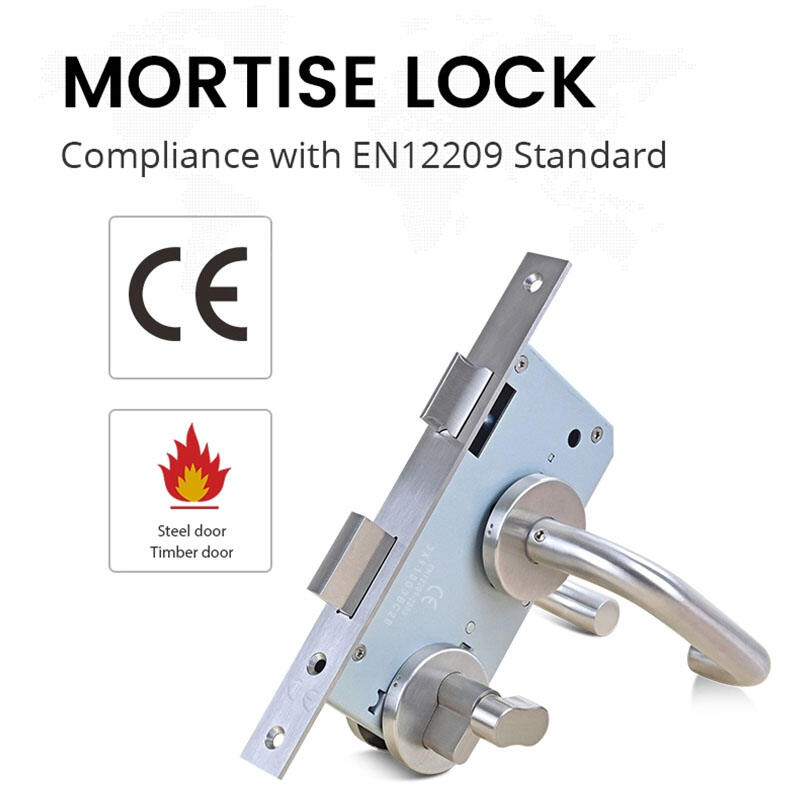
Security Advantages of CE Mortise Locks in High-Traffic Public Buildings
Public buildings with heavy foot traffic—such as airports, hospitals, and government facilities—require locking systems that combine uncompromising security with long-term reliability. CE-certified mortise locks meet these demands through advanced mechanical engineering, compliance with international safety standards, and adaptable designs that support both functionality and architectural integrity.
Advanced Security Features of CE Mortise Locks for Access Control
CE mortise locks feature a deeply recessed deadbolt extending 15–25 mm into the door frame, offering superior resistance to forced entry compared to standard cylindrical locks. Multi-layered defenses—including anti-drill plates, pick-resistant cylinders, and reinforced strike boxes—address common hardware vulnerabilities exploited in 83% of unauthorized access attempts (Ponemon 2023).
How CE Mortise Locks Outperform Standard Door Locks in Public Settings
Regular door locks tend to wear out fast when used repeatedly because their bolts don't engage deeply enough and they're made from lightweight materials. That's where CE mortise locks stand apart. These bad boys have solid brass or stainless steel parts inside that can handle way more than 500 thousand open-close cycles according to testing. What makes them really useful is how they fit together. The design lets building managers connect them to electronic access systems if needed, but there's still a good old fashioned keyhole for emergencies. So even when the electricity goes out or something goes wrong with the system, people can still get out safely without getting stuck.
CE Certification and International Security Standards in Lock Manufacturing
CE certification confirms adherence to EN 12209 and EN 14846, which mandate rigorous testing for durability, fire resistance, and attack resistance. Certified locks must withstand an axial force of 15 kN (approximately 3,370 lbs) on the deadbolt and endure 10 hours of sustained tampering without failure.
Balancing Aesthetic Design with Maximum Security in Public Spaces
Available in over 20 finishes, modern CE mortise locks include slim escutcheons and concealed screw designs that blend seamlessly into sensitive environments like museums and historic buildings. With a 34% smaller footprint than bulkier electronic alternatives, they deliver Grade 1 security without compromising architectural aesthetics.
Durability and Long-Term Performance in Demanding Public Environments
Built to Last: Strength of CE Mortise Locks Under Heavy Use
Engineered for up to 1 million operational cycles—triple the lifespan of typical commercial locks—CE mortise locks incorporate hardened steel cores and anti-corrosion zinc alloys. Independent testing per EN 12209:2016 shows they retain 98% of their mechanical integrity after stress tests simulating 15 years of continuous public use.
Widespread Use in Schools, Hospitals, and Government Facilities
In the past few years since 2020, around three out of four public buildings across Europe that switched to CE-certified mortise locks have not experienced any security issues caused by faulty hardware. The thing is, these locks can take quite a beating too they easily manage over 300 lock/unlock cycles each day without showing signs of wear and tear. What makes them stand out? Their sealed internal parts keep dust and moisture from getting inside, which matters a lot in hospitals and clinics. We all know how often those places get cleaned, right? Regular disinfecting would quickly ruin standard lock mechanisms, but these special ones hold up much better under such conditions.
Case Study: 10-Year Reliability of CE Mortise Locks in Urban Transit Hubs
A longitudinal study across 12 major metro stations found CE mortise locks achieved:
- 97.3% operational reliability despite 3.8 million annual door activations
- 62% lower maintenance costs versus previous non-certified systems
- Zero emergency replacements during extreme temperatures (-20°C to 45°C)
This track record explains why transit authorities worldwide specify CE-certified hardware for gates, emergency exits, and staff access points requiring decade-long dependability.
Fire Safety Compliance and Emergency Egress Integration
Fire-Rated CE Mortise Locks and Compliance with Life Safety Codes
CE certified mortise locks can withstand temperatures over 1000 degrees Celsius for around an hour, which satisfies the latest EN 1634 standards from 2023. These locks feature special intumescent seals that swell when exposed to heat, effectively sealing off smoke pathways through doors. Smoke inhalation remains a major threat in fires, responsible for roughly 60 percent of all fire fatalities according to recent NFPA data. What sets these modern locks apart from older versions is their ability to work seamlessly with fire door closers. This integration means doors will automatically shut tight during emergencies, containing flames and toxic gases within designated areas until help arrives.
Emergency Override Mechanisms in Public Safety Lock Systems
CE mortise locks feature fail-safe dual-action override systems:
- Push-to-exit bars enable single-motion egress, accessible even to individuals with mobility impairments
- Electromagnetic releases disengage locks instantly during power loss or alarm activation
In earthquake-prone regions, schools using these systems have reduced evacuation times by 40% while maintaining secure lockdown protocols (Public Safety Institute 2023).
Reconciling High Security with Safe and Inclusive Egress Requirements
Modern CE mortise locks are built according to accessibility guidelines like ADA and EN 17210, featuring tactile levers that can be operated without any force. Hospitals often install special versions of these locks that automatically unlock when there's an emergency situation, yet stay locked at all other times. This helps maintain infection control protocols while still allowing people to evacuate quickly if needed. The fact that these locks comply with multiple standards means facilities don't have to install different systems for different requirements, which cuts down on installation expenses somewhere around 20 to 30 percent depending on the project size and complexity.
Smart Integration: Electronic Mortise Locks in Modern Public Infrastructure
Rising Adoption of Electronic CE Mortise Locks in Public Spaces
More than 40 percent of public buildings across the European Union have started using CE certified electronic mortise locks for managing entry points these days, marking about a 15 point jump from numbers back in 2021 according to the Public Security Trends Report for 2023. Libraries, city hall offices, and other similar places can control who gets in through smartphones, temporary codes, or even fingerprint scanners without worrying about meeting those EN 14846 standards for lasting performance. Getting rid of actual metal keys cuts down on unauthorized copies and creates thorough records of who accessed what when. This matters a lot for places where confidential information is stored or where staff work with people who need extra protection.
Adapting Infrastructure for Smart Lock Technologies
The latest CE certified electronic mortise locks tackle those annoying retrofit problems thanks to their energy efficient Bluetooth tech and adjustable backsets. They fit right into different door types like steel, wood, or composite materials without needing any major changes to existing structures. Take Germany for example where nearly three out of four hospitals undergoing renovations have switched to these flexible lock systems. This allows them to keep their historic building character intact while still getting all the modern security benefits they need for today's facilities.
Integration with Centralized Security and Building Management Systems
Advanced CE mortise locks connect to facility-wide platforms using open protocols like OSDP and BACnet, enabling:
- Real-time monitoring of door status across multi-building campuses
- Automated lockdown responses triggered by fire alarms or security threats
- Energy efficiency improvements through coordinated HVAC adjustments when doors remain closed
A 10-year analysis of Berlin’s U-Bahn stations revealed that integrated mortise lock systems achieved 99.97% uptime and reduced maintenance expenses by 33%, proving their resilience in high-traffic transit environments. Centralized control also enhances accessibility by allowing immediate route adjustments for wheelchair users during emergencies.
FAQ
What are CE Mortise Locks?
CE Mortise Locks are high-security door locks that are CE-certified, adhering to international standards for security and durability. They are designed for high-traffic public buildings and are known for their advanced security features and long-term reliability.
Why are CE Mortise Locks preferred in public buildings?
CE Mortise Locks are preferred in public buildings due to their superior resistance to forced entry, compliance with rigorous testing standards, and adaptability with modern access control systems. They ensure security while maintaining architectural integrity.
How do CE Mortise Locks comply with fire safety standards?
CE Mortise Locks comply with fire safety standards by withstanding temperatures over 1000 degrees Celsius for about an hour, equipped with intumescent seals to block smoke pathways. They integrate seamlessly with fire door closers for emergency situations.
What is the significance of electronic CE Mortise Locks?
Electronic CE Mortise Locks allow advanced access control via smartphones, codes, or fingerprint scanners, eliminating the need for physical keys. They provide security records and are ideal for facilities handling confidential information.